
Import RNA counts, cell metadata and saved PCA and UMAP coordinates from a Seurat RDS file. This tutorial uses a 1,000-cell PBMC example, followed by a tiny synthetic file that shows how CyteArc handles skipped metadata and an active SCT assay. No R session is needed.
The PBMC file is Hua Yichao’s SeuratExtend example data, licensed under CC0 and derived from 10x Genomics data under CC BY 4.0. The synthetic file was made for CyteArc and uses its BSD-3-Clause license. See Third-party notices for data credits.
Download and inspect the PBMC object
Download the file from CyteArc’s public example bucket, then check its contents.
# Work with local file paths.
from pathlib import Path

# Keep each import in a fresh directory.
from tempfile import TemporaryDirectory

# Download the example RDS file.
from huggingface_hub import download_bucket_files

# Display inspection results as tables.
import pandas as pd

# Inspect and import Seurat objects.
import cytearc

# Hide routine progress messages.
cytearc.configure_output(level="WARNING", progress=False)

# Show full import notices in the tables below.
pd.set_option("display.max_colwidth", None)

# Choose where to save the downloaded file.
data_directory = Path("cytearc_datasets")

# Create the download directory if needed.
data_directory.mkdir(exist_ok=True)

# Name the local RDS file.
rds_path = data_directory / "seurat_v4_1_3_pbmc_mye.rds"

# Download the public PBMC example.
download_bucket_files(
    "Nygen/cytebase",
    files=[("cytearc_tests/seurat_v4_1_3_pbmc_mye.rds", rds_path)],
    token=False,
    raise_on_missing_files=True,
)

# Keep the converted stores in a temporary directory.
work = TemporaryDirectory()

# Use this directory for each import below.
output_directory = Path(work.name)Started: 2026-10-23T14:34:31.338706Z | Wall time: 3.334 s
# Inspect the assays, metadata and saved coordinates.
inspection = cytearc.inspect_seurat(rds_path)

# Check that the downloaded file matches the published example.
assert inspection.sourceDigest == "f84adf523a78aeb6e6681cf09e06a2a2fcd4e3fe857fdd89b17e90a1782fac3d"

# Show the active assay and cell count.
print("Active assay:", inspection.activeAssay, "| Cells:", inspection.nCells)

# List the assays and their feature-by-cell dimensions.
pd.DataFrame(inspection.assays, columns=["name", "dimensions", "importable"])
Active assay: RNA | Cells: 1000
| name | dimensions | importable | |
|---|---|---|---|
| 0 | RNA | (17195, 1000) | True |
Started: 2026-10-23T14:34:34.675647Z | Wall time: 1.370 s
# List the saved coordinates, their cell-by-dimension shapes and their roles.
pd.DataFrame(inspection.reductions, columns=["name", "dimensions", "role", "assayUsed"])| name | dimensions | role | assayUsed | |
|---|---|---|---|---|
| 0 | pca | (1000, 50) | graphCoordinates | RNA |
| 1 | umap | (1000, 2) | displayEmbedding | RNA |
Started: 2026-10-23T14:34:36.049131Z | Wall time: 0.011 s
# Open the RDS to read its metadata column names.
with cytearc.SeuratReader(rds_path) as reader:

    # Keep the names before closing the reader.
    metadata_names = reader.cellMetadata.columnNames

# Show the columns available for import.
metadata_names
('orig.ident',
'nCount_RNA',
'nFeature_RNA',
'percent.mt',
'seurat_clusters',
'cluster')Started: 2026-10-23T14:34:36.063574Z | Wall time: 0.710 s
Select metadata and reductions
Keep RNA counts, PCA, UMAP and four metadata columns. cell_metadata chooses the columns;
default_assay chooses which imported assay later analyses use by default.
Use reduction_roles to mark PCA as coordinates for a graph and UMAP as a display layout.
These roles are already recognized in this file, but naming them shows how to override a
role when needed. The coordinates are imported as they are.
# Choose the output store.
pbmc_store = output_directory / "pbmc.zarr"

# Select the counts, metadata and saved coordinates.
with cytearc.SeuratReader(
    rds_path,
    assays=["RNA"],
    reductions=["pca", "umap"],
    cell_metadata=["orig.ident", "nCount_RNA", "nFeature_RNA", "percent.mt"],
    reduction_roles={"pca": "coordinates", "umap": "umap"},
) as reader:

    # Write the store with RNA as its default assay.
    imported = cytearc.SeuratToZarr(
        reader, zarr_loc=str(pbmc_store), default_assay="RNA",
        nthreads=4, mem_budget="4G",
    ).dump()

# Show the imported assays and default.
print("Imported assays:", imported.assayNames, "| Default:", imported.defaultAssay)

# Show what the import left out.
pd.DataFrame(imported.notices, columns=["code", "objectPath", "message"])
Imported assays: ('RNA',) | Default: RNA
| code | objectPath | message | |
|---|---|---|---|
| 0 | ignored_seurat_slot | commands | Seurat slot 'commands' is not imported |
| 1 | ignored_normalized_layer | assays/RNA/data | normalized slot 'data' is not imported |
| 2 | ignored_normalized_layer | assays/RNA/scale.data | normalized slot 'scale.data' is not imported |
| 3 | ignored_assay_slot | assays/RNA/var.features | assay slot 'var.features' is not imported |
| 4 | ignored_reduction_slot | reductions/pca/misc | reduction slot 'misc' is not imported |
Started: 2026-10-23T14:34:36.776823Z | Wall time: 5.413 s
The commands notice says that Seurat’s command history was omitted. Counts, selected
metadata, identities and coordinates were imported. Review these notices to see which
parts of your source object were kept.
# Open the imported store without filtering its cells.
ds = cytearc.DataStore(str(pbmc_store), min_features_per_cell=-1, nthreads=4)

# Inspect the imported cell and feature counts.
ds
DataStore has 1000 (1000) cells with 1 assays: RNA
Cell metadata:
'I', 'ids', 'names', 'RNA_nCounts', 'RNA_nFeatures',
'RNA_percentMito', 'RNA_percentRibo', 'nCount_RNA', 'nFeature_RNA', 'orig.ident',
'percent.mt'
RNA assay has 17195 features and following metadata:
'I', 'ids', 'names', 'dropOuts', 'nCells',
'vst.mean', 'vst.variable', 'vst.variance', 'vst.variance.expected', 'vst.variance.standardized'Started: 2026-10-23T14:34:42.194696Z | Wall time: 2.002 s
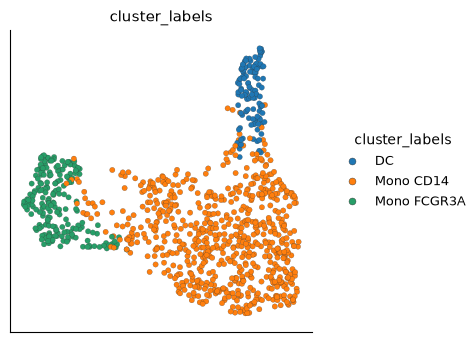
# Plot the saved Seurat UMAP using the saved active identities.
ds.plots.embedding(
    layout=imported.reductionArtifacts["umap"],
    color_by=imported.activeIdentity,
)
Started: 2026-10-23T14:34:44.200005Z | Wall time: 1.564 s
Pass the imported layout and identities directly to plots.embedding, as above. To build
a graph from the saved PCA, pass imported.reductionArtifacts["pca"] to
ds.graph.ann_index; see Build a neighborhood graph stage by stage.
Read partial-import notices
The PBMC file has no unsupported metadata or SCT assay. The small file below adds a
list-valued notes column, an active SCT assay derived from RNA, and coordinates called
layout. Its three cells and two genes are synthetic. The file is embedded in the
notebook so this example also works in the downloaded copy.
Source
# Decode the embedded example file.
import base64

# Choose a path for the synthetic RDS.
partial_path = output_directory / "partial.rds"

# Write the embedded bytes to that path.
partial_path.write_bytes(base64.b64decode(
    'H4sIAAAAAAAC/+1VT2+bMBQ3EGhAY4u0HdoPMaRml92WqtNu26HtpN6iF3AjNBtXYLLlW+8TVLXD'
    'MyXUJFSbtMsiOX62f+/5/fn5cRsRQjwymah/X4nE/37z5f1HtTojZOKqDUeNUI0Aqgq2FSHuW7Vy'
    'bYhU1IXUiFivSPNzGrS6pF3vaXlZztUUIwyhe5CpghTAqTJN8HIyw1mfu+vzVprjmWd20vYsnbfS'
    'h94NfspUeD2zAQdZ5r8MBMoStkp46OnGnEpI7ijIuqQmP6R/gfF/ZjkMS/Ez6QIGAht22WxGGWhf'
    'SmXL4qlVxb/QdW3QI0rq2sf/kv6bksbXlzdfRUZZwvJKoqeOpZJhzfMEsNRd+97Vt4sxfkzNTTZi'
    'dSNtN/kQesh8h4nD5t09vxtR6VrUwl0VdfowL16PSGEK97rCSxi1EaOqtu/j3DVrPHOMtrPqBemk'
    'A3TZi9C4F1TA7xk1PCgu9VtcPoXtF0JqpcPE+4NXM46CryCV+YbaybWrjBWeZ7SQ2FhMVh3L9yFg'
    'dENZ3yUPGBvjenCnrhPlmHQPJuhZxFFJs1pFIYrqwIt7k1LGEspXNMvyYq2hr7VHn343BFjgB3Ex'
    'xRmJsXiH8ykCDjZXz9J/h5rr8Ui7NJ6mdSUFX5731vO/2Ghn2GMTJqCbpCNB2/JiC/rhWPd5obvR'
    'juNJXdHseBcN1kysQDfACHefvfpKZnSjBGvIP2j/NZ1gBUb10885v9I0HduuAwZbUcux/Tq4pnUJ'
    'O/gjxAGVbkQKAAA='
))581Started: 2026-10-23T14:34:45.766877Z | Wall time: 0.009 s
# Inspect the small file before importing it.
partial_inspection = cytearc.inspect_seurat(partial_path)

# Show its active assay.
print("Active assay:", partial_inspection.activeAssay)

# Show the role inferred for the coordinates called layout.
print("Inferred role:", partial_inspection.reductions[0].role)

# Show which metadata could not be read.
pd.DataFrame(
    partial_inspection.cellMetadata.notices, columns=["code", "objectPath", "message"]
)
Active assay: SCT
Inferred role: graphCoordinates
| code | objectPath | message | |
|---|---|---|---|
| 0 | skipped_metadata_column | meta.data/notes | cell metadata column 'notes' is not imported: metadata column uses unsupported R type VECTOR |
Started: 2026-10-23T14:34:45.778787Z | Wall time: 0.031 s
The reader skips the list-valued notes column and keeps the scalar columns.
If a column is essential, name it in cell_metadata: an unsupported column then raises
an error instead of being skipped.
The name layout was treated as graph coordinates. We know it is a display layout,
so set its role explicitly when importing it.
# Set the custom coordinates to a display role and keep all usable data.
with cytearc.SeuratReader(
    partial_path, reduction_roles={"layout": "umap"}
) as reader:

    # Import the data and let the writer choose the default assay.
    partial_import = cytearc.SeuratToZarr(
        reader, zarr_loc=str(output_directory / "partial.zarr"),
        nthreads=4, mem_budget="1G",
    ).dump()

# Show which assays were imported and which became the default.
print("Imported assays:", partial_import.assayNames, "| Default:", partial_import.defaultAssay)

# Show the role assigned to the custom layout.
print("Layout kind:", partial_import.reductionArtifacts["layout"].kind)

# Read the skipped-column and SCT notices.
pd.DataFrame(partial_import.notices, columns=["code", "objectPath", "message"])
Imported assays: ('RNA', 'SCT') | Default: RNA
Layout kind: embedding
| code | objectPath | message | |
|---|---|---|---|
| 0 | sct_default_assay | active.assay | active assay 'SCT' holds SCTransform-corrected counts, so the default assay is 'RNA', whose raw counts its models were fitted to; pass default_assay='SCT' to keep the active assay |
| 1 | skipped_metadata_column | meta.data/notes | cell metadata column 'notes' is not imported: metadata column uses unsupported R type VECTOR |
| 2 | sct_corrected_counts | assays/SCT/counts | counts of SCTAssay 'SCT' are SCTransform-corrected counts, not the raw counts of assay 'RNA' |
| 3 | ignored_assay_slot | assays/SCT/SCTModel.list | assay slot 'SCTModel.list' is not imported |
Started: 2026-10-23T14:34:45.812997Z | Wall time: 1.246 s
The import kept both assays and made RNA the default. The sct_default_assay notice
explains why: SCT holds corrected counts, and its model identifies RNA as their raw-count
source. This choice is reported by the writer, after inspection.
Choose a raw-count default explicitly
To keep only RNA, select it and set default_assay="RNA". The default must be an imported
assay. Use raw counts for analyses that require them; choosing SCT explicitly would make
its corrected counts the default.
# Select RNA counts, two metadata columns and the display layout.
with cytearc.SeuratReader(
    partial_path,
    assays=["RNA"],
    cell_metadata=["sample", "nCount_RNA"],
    reductions=["layout"],
    reduction_roles={"layout": "umap"},
) as reader:

    # Write a store with RNA as its explicit default.
    raw_import = cytearc.SeuratToZarr(
        reader, zarr_loc=str(output_directory / "raw.zarr"),
        default_assay="RNA", nthreads=4, mem_budget="1G",
    ).dump()

# Show the selected assay, its default and any import notices.
{
    "assays": raw_import.assayNames,
    "default": raw_import.defaultAssay,
    "notices": [item.code for item in raw_import.notices],
}
{'assays': ('RNA',), 'default': 'RNA', 'notices': []}Started: 2026-10-23T14:34:47.064303Z | Wall time: 0.438 s
See CyteArc for Seurat users for the workflow map and Import and export for H5AD and Matrix Market export.