Single-cell ATAC-seq measures chromatin accessibility: regions where DNA is accessible to the assay. Its features are peaks, genomic intervals with accessibility signal. A peak may overlap a gene, promoter, or other regulatory region; its coordinates tell us where to look in the reference genome.
Here we use a prepared PBMC analysis to find populations with similar accessibility. We then combine peaks overlapping gene regions into GeneScores and ask which broad cell identities their marker patterns support.
Open the prepared ATAC result
# Open count stores and run CyteArc analyses.
import cytearc

# Keep routine logs and progress bars out of the results.
cytearc.configure_output(level="WARNING", progress=False)

# Download the prepared example store.
dataset = cytearc.cytebase.connect("cytearc_docs").download_dataset(
    "tenx_10K_pbmc-v1_atacseq",
    destination="cytearc_datasets",
    zarr=True,
)

# Open the count store for this analysis.
ds = cytearc.DataStore(f"{dataset}/data.zarr", default_assay="ATAC", nthreads=4)

# Inspect the opened store's cells and features.
ds
DataStore has 8426 (8728) cells with 1 assays: ATAC
Cell metadata:
'I', 'ids', 'names', 'ATAC_UMAP1', 'ATAC_UMAP2',
'ATAC_leiden_cluster', 'ATAC_nCounts', 'ATAC_nFeatures'
ATAC assay has 89796 features and following metadata:
'I', 'ids', 'names', 'derivation', 'dropOuts',
'feature_type', 'genome', 'nCells'Started: 2026-10-11T18:54:53.890447Z | Wall time: 24.475 s
Preprocessing is complete in this store. Retrieve its UMAP and Leiden clusters:
# Select the saved ATAC clusters; require exactly one match.
clusters = ds.artifacts.find("clusters", from_assay="ATAC", method="leiden")

# Select the saved ATAC UMAP; require exactly one match.
umap = ds.artifacts.find("embedding", from_assay="ATAC", method="umap")

# Inspect the saved ATAC clustering and layout.
{"clusters": clusters, "UMAP": umap}
{'clusters': ArtifactRef(assay='ATAC', kind='cluster_labels', artifact_id='aa627598be0d...'),
'UMAP': ArtifactRef(assay='ATAC', kind='embedding', artifact_id='2307d298e8cf...')}Started: 2026-10-11T18:55:18.368760Z | Wall time: 0.017 s
Find accessibility populations
# Locate the ATAC clusters before interpreting their markers.
ds.plots.embedding(layout=umap, color_by=clusters, legend_loc='on_data')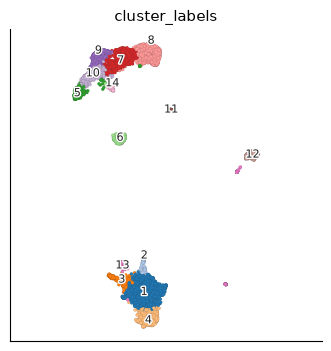
Started: 2026-10-11T18:55:18.389241Z | Wall time: 1.619 s
Each point is a cell. Nearby cells tend to share accessible peaks. The numbered clusters give us groups to investigate, but we need marker evidence to attach biological names.
Connect peaks to genes
A BED file describes genomic intervals and their gene names. Use an annotation built for
the same reference genome as the peaks; this dataset uses GRCh37. CyteArc combines the
accessibility signal from overlapping peaks into a new assay named GeneScores.
Here renormalization=False keeps the combined scores without an extra rescaling during
assay construction. assay_type="RNA" gives the new assay RNA-style normalization for
plotting. This does not turn accessibility into measured RNA expression.
# Download gene intervals for the dataset's reference genome.
annotations = cytearc.cytebase.connect("cytearc_docs").download_dataset(
    "annotations",
    destination="cytearc_datasets",
)

# Combine peaks overlapping gene intervals into GeneScores.
ds.add_melded_assay(
    from_assay="ATAC",
    external_bed_fn=f"{annotations}/human_GRCh37_gencode_v38_gene_body.bed.gz",
    renormalization=False,
    assay_label="GeneScores",
    assay_type="RNA",
)

# Inspect the opened store's cells and features.
ds
WARNING: Chromosome chrM not in the input peak coordinates
WARNING: 33935/62446 features did not overlap with any peak
DataStore has 8426 (8728) cells with 2 assays: ATAC GeneScores
   Cell metadata:
            'I', 'ids', 'names', 'ATAC_UMAP1', 'ATAC_UMAP2',
            'ATAC_leiden_cluster', 'ATAC_nCounts', 'ATAC_nFeatures', 'GeneScores_nCounts', 'GeneScores_nFeatures',
            'GeneScores_percentMito', 'GeneScores_percentRibo'
   ATAC assay has 89796 features and following metadata:
            'I', 'ids', 'names', 'derivation', 'dropOuts',
            'feature_type', 'genome', 'nCells'
   GeneScores assay has 62446 features and following metadata:
            'I', 'ids', 'names', 'dropOuts', 'nCells'
Started: 2026-10-11T18:55:20.011000Z | Wall time: 46.551 s
Annotation genes with no overlapping peaks remain as zero-count features and are marked invalid. They are not evidence that a gene is inaccessible in every biological setting.
Read the marker maps
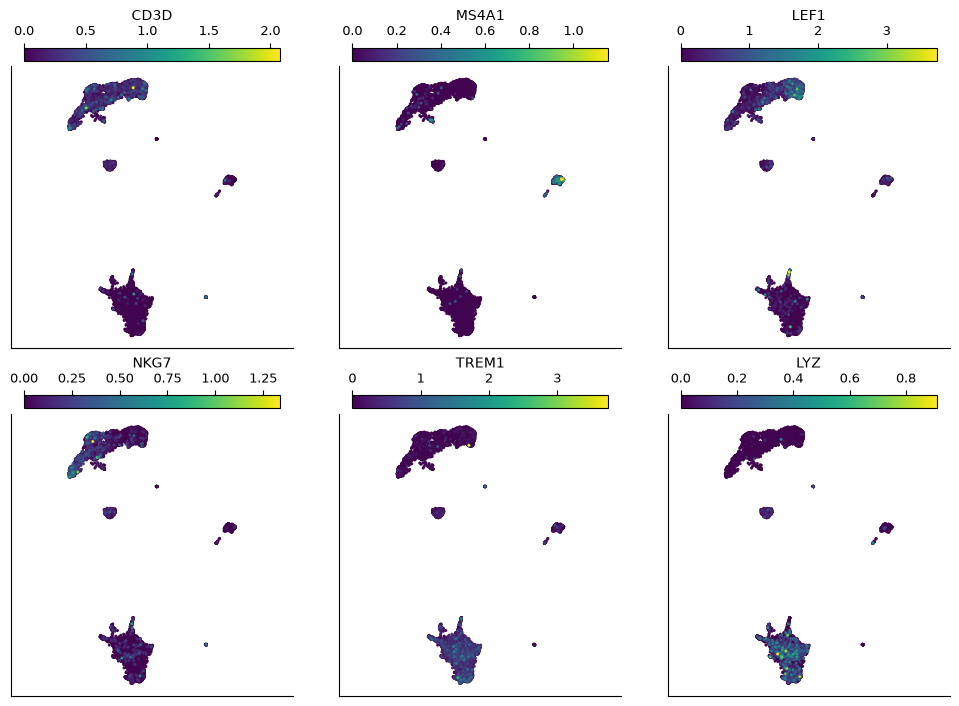
# Compare GeneScores for lymphoid and myeloid markers.
ds.plots.embedding(
    layout=umap,
    from_assay="GeneScores",
    color_by=["CD3D", "MS4A1", "LEF1", "NKG7", "TREM1", "LYZ"],
    n_columns=3,
    sort_values=True,
)
Started: 2026-10-11T18:56:06.565526Z | Wall time: 3.278 s
CD3D and LEF1 support T-cell regions, MS4A1 supports B cells, and NKG7 highlights cytotoxic or NK-like populations. TREM1 together with LYZ supports myeloid populations. Look for agreement across markers rather than assigning a type from one bright panel. See Annotate cell types and states for broader panels and checks against alternative identities.
Start from your own peak counts
Convert and open a peak-count matrix with default_assay="ATAC" as shown in
Import and export. After reviewing its quality measurements in
Quality control across assays, this sequence uses the default settings to build a first result:
# Open your own ATAC count store.
own_ds = cytearc.DataStore("my_atac.zarr", default_assay="ATAC")

# Filter cells using the available quality measurements.
cells = own_ds.qc.auto_filter()

# Select peaks detected across the retained cells.
peaks = own_ds.features.prevalent_peaks(cells)

# Normalize counts over the selected features.
normalized = own_ds.features.normalize(cells, peaks)

# Reduce TF-IDF normalized accessibility with LSI.
lsi = own_ds.reduction.lsi(normalized)

# Build starting coordinates for the embedding.
initialization = own_ds.embeddings.initialization(lsi)

# Build the nearest-neighbor search index from LSI.
neighbor_index = own_ds.graph.ann_index(lsi)

# Find neighbors of each cell in the reduced space.
neighbors = own_ds.graph.neighbors(neighbor_index)

# Convert neighbor distances into weighted connectivity.
graph = own_ds.graph.connectivity(neighbors)

# Keep the saved UMAP coordinates for the figures.
layout = own_ds.embeddings.umap(graph, initialization)

# Find groups of cells in the graph.
clusters = own_ds.clusters.leiden(graph)
For ATAC, normalization uses TF-IDF and dimensionality reduction uses LSI. Treat defaults as a starting point: inspect the retained cells and marker patterns before adjusting peak selection, LSI dimensions, or neighborhood size. The next steps are explained in Feature selection: choosing informative features, Choosing dimensionality reductions, and Build a neighborhood graph stage by stage.
Common mistakes and limitations
Reading accessibility as expression: an accessible region does not guarantee transcription or protein production, and GeneScores combine peak signal into an RNA-style assay without measuring RNA.
Trusting the annotation’s reach: scores depend on the intervals you supply, so gene-body scores miss distant regulatory elements, and genes with no overlapping peaks remain invalid zero features rather than evidence of inaccessibility.
Resolving fine identities with a broad panel: the marker patterns shown here support lineage-level calls; finer states need additional markers and independent evidence.